
When should an app lower your weight?
After a hard week in which the reps were missed, after time away, and in the lighter week that ends a block. A lift you did not train last week holds. The rest of the time the weight goes up only when the reps earned it.
This is for anyone who has used an app that only ever added weight, and stalled or got hurt around month two.
Why did my app reduce my weight?
Because the log said so. An app that sets next week’s loads from what you actually lifted has to be able to say three things: more, the same, and less. More is the one everyone notices. The other two keep it from running away.
Four situations point down or hold: a hard week with reps missed, time away, the last week of a block, and a lift you did not train last week. The rest of this page takes them one at a time.
Should I lower the weight if I missed reps?
It depends on how hard the week was.
If the session felt normal and you fell a rep or two short on the last set, hold. The instruction is “reach the top of the range first”. The missing reps are the coming week’s work, and when every set gets there the load moves.
If the session was hard and you still missed reps, a hold is the wrong call. A load that just beat you at full effort tends to beat you again the next week, with more fatigue in the system and the same numbers in the log. Slightly lighter for one week lets the reps come back. The reps are the signal everything else runs on.
Given the choice, I would rather a lifter admit a session was hard and be wrong about it than call it normal and keep missing. The first costs one lighter week. The second costs the month.
None of this is a soft option. The accepted criterion for adding load, from the American College of Sports Medicine’s position stand on progression, is reps completed beyond the target on two consecutive sessions (Ratamess et al., 2009, Medicine & Science in Sports & Exercise). A hard miss is the mirror of that rule: reps below target with effort already at the ceiling. The load is ahead of the lifter, and the fix is to let the lifter catch up.
Nor is a lighter week lost ground. An eight-week randomized trial in trained lifters compared raising the load every week with raising the reps at a fixed load. Both groups grew the same amount of muscle, and strength tilted toward the load group by an amount the authors called of questionable practical significance (Plotkin et al., 2022, PeerJ). A week of clean, full reps at a slightly lower weight is a week of progress by the measure that matters most.
A worked example: bench, 60 kg, four weeks
The plan says bench 60 kg (132 lb) for three sets of six to eight.
- Week 1. Clean sets, one rep short of the top on the last one. Hold: reach the top of the range first.
- Week 2. Every set short, nothing left, and the session was a fight. Next week is a little lighter: one small plate off each side, the plates that spend most of the week at the bottom of the tree under the 20s.
- Week 3. Every set at the top, and the session feels like work rather than a fight.
- Week 4. Back to 60 kg, every rep this time. Another full week at the top earns the next step.
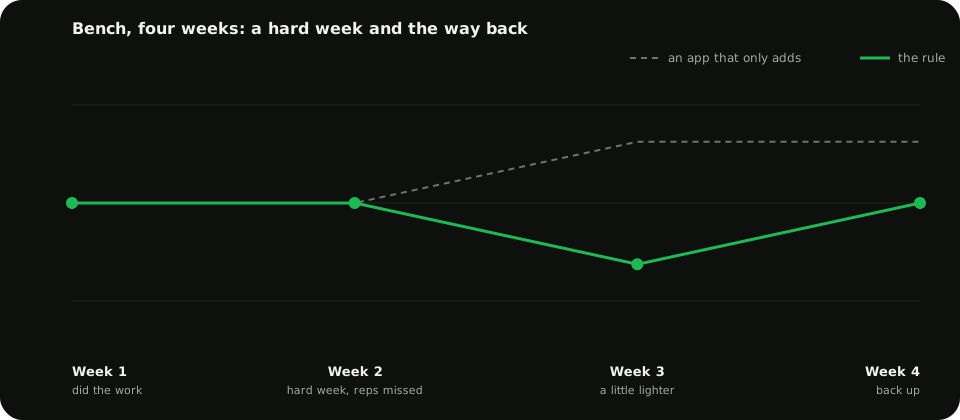
What the dip bought is week 4. Without it, week 3 is the same misses again, with more fatigue, and the stall sets in. The next-week load calculator shows the same shape for any weight you enter.
Why come back lighter after time away?
Because strength is partly a skill, and skill goes stale faster than muscle. A 2024 trial put 39 trained lifters through nine weeks of training and had half of them take a complete week off at the midpoint. The rested group ended with less lower-body strength than the group that trained through, while muscle size, power and endurance were the same (Coleman et al., 2024, PeerJ). One week off cost some strength and left size alone.
After a longer break the muscle is still there. What has drifted is the bar path and the sense of how heavy a weight should feel. A lighter week brings those back, and because what you are rebuilding is mostly skill, one week is enough. The week after is a normal week at the old loads.
The evidence here is thinner than it looks. The trial tested a single week off, and where a short break turns into a long one is coaching practice rather than a tested threshold.
One missed week is different. Hold the loads and train. Only a longer break earns the lighter week.
What is the deload at the end of a block for?
A deload is a planned lighter week: less load, fewer sets, the same exercises on the same days. A 2023 Delphi study asked experienced strength and physique coaches, over three rounds, what it is. Their consensus: a period of reduced training stress designed to reduce physiological and psychological fatigue, aid recovery, and improve readiness for the training that follows (Bell et al., 2023, Sports Medicine – Open). Volume should come down, the panel agreed, and load may come down as well.
A block of hard weeks builds fatigue even when every week went well. The deload sheds it before the next block, and the week after begins at the loads you finished on. When to deload covers the signs outside a program.
What about a lift I skipped last week?
It holds. You trained three days, the deadlift session fell to a late meeting, the other two went well. Next week’s deadlift is last week’s plan.
A good week on the bench is evidence about the bench. It says nothing about a deadlift you did not do, and an app that raises every lift because the week went well has stopped reading the log.
Why do apps that only add weight fail by month two?
An app that adds 2.5 kg to the bench every session, three sessions a week, adds 7.5 kg a week. A 60 kg bench is 120 kg by week 9. Nobody’s bench does that. The rule is a counter, not a reader, and a counter has no way to notice that the lifter stopped keeping up in week 5.
On the floor one of two things happens. The lifter shortens the range and logs sets that were not quite done, which is ego lifting with the app’s encouragement, and the log stops being true. Or the plan outruns the lifter by a plate or two and the lifter quits, usually with the sense that they failed the app, when the arithmetic failed them. Both end around month two, because that is how long an unbounded step takes to leave the body behind.
The missing piece is a rule that can say no, and sometimes less. A rule that reads the log can hold, step up or step down. One that reads nothing can only count.
Isn’t a ceiling the opposite idea?
It is the same idea from the other side. A rule that lowers the load after a hard miss also refuses to raise it by more than a bounded step, however good the week looked. A hard ceiling on one week’s jump is the other half of the willingness to go down.
Both halves say the load follows the log at a pace the body can match. Down after a hard miss, up after a full week at the top of the range, never a leap. The ceiling earns its keep after a typo in the log or a coach’s suggestion that got ahead of itself.
What can I override?
Less than you might want, and that is deliberate.
The coach’s suggestions, yes. When a coach suggests a load change, a different rep target, a moved day or a swapped exercise, it arrives as a card. You accept it or ignore it.
The weekly rule, no. The rule that reads last week’s log and sets this week’s loads is not negotiable, and the reason is the day you would overrule it. That is the Monday after a hard week when you feel strong again and want the old number back now. A rule you can talk out of on that Monday is a suggestion, and a suggestion gives you the month-two stall by a longer road.
What stays in your hands is the gym and the log. Load any bar you like. Next week starts from the load you actually logged, so log the reps as they were.
What the evidence on this page actually tested
| Study | What it compared | What it found |
|---|---|---|
| Ratamess et al., 2009 (ACSM position stand) | The literature on progression, summarised as guidance | Add load once reps beyond the target arrive on two consecutive sessions |
| Plotkin et al., 2022 (PeerJ) | Eight weeks of adding load against adding reps at a fixed load, trained lifters | The same muscle growth either way, strength tilted slightly toward load |
| Bell et al., 2023 (Sports Medicine – Open) | Three rounds of expert consensus on deloading | A planned period of reduced stress to shed fatigue and restore readiness |
| Coleman et al., 2024 (PeerJ) | Nine weeks of training with or without a full week off in the middle | The week off cost some lower-body strength and left muscle size alone |
None of the four tested a weekly rule against a naive counter, and the line between a short break and a long one is practice rather than a result. What they do support is the shape: reps earn load, a lighter week costs no muscle, and a week of nothing costs some strength.
How does BurnX apply this?
In BurnX a lift’s weight goes up when you did the work last week, holds when you did not, and comes down after a hard week, after time away and in the last week of a block, with the Monday report saying which and why. The coach’s suggestions sit under the same hard ceiling. How BurnX decides next week’s weights is the promise in full, how the coach works covers what it may suggest, and the next-week load calculator shows what a week of your numbers does to the next. More guides are in the hub.
Sources
- Ratamess NA et al. (2009). American College of Sports Medicine position stand. Progression models in resistance training for healthy adults. Medicine & Science in Sports & Exercise, 41(3), 687–708. PubMed
- Plotkin D et al. (2022). Progressive overload without progressing load? The effects of load or repetition progression on muscular adaptations. PeerJ, 10, e14142. PeerJ
- Bell L et al. (2023). Integrating deloading into strength and physique sports training programmes: an international Delphi consensus approach. Sports Medicine – Open, 9, 87. PMC
- Coleman M et al. (2024). Gaining more from doing less? The effects of a one-week deload period during supervised resistance training on muscular adaptations. PeerJ, 12, e16777. PeerJ