
BurnX writes your program for your goal, days and equipment, and sets each lift’s weight every week from what you actually lifted. The coach, an AI you switch on once, can suggest changes along the way: a training day, an exercise, a rep target or a load, a meal. Every suggestion is a card you accept or ignore. None can pass the hard ceiling.
If you have seen “AI trainer” in a store listing before and want to know what the AI controls, this is the page.
What does the AI actually do in BurnX?
Less than the phrase suggests, and the parts it does are the parts you can see.
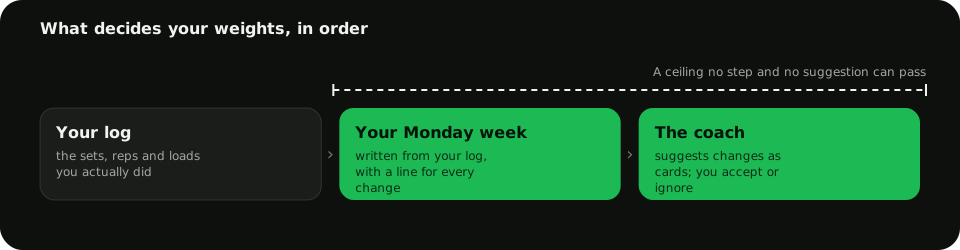
- Your log. In each session you record the weight you lifted and the reps you got. Everything that follows is built on that.
- Your Monday week. Each lift’s working weight for the week comes from what you lifted the week before, and a short report says what changed and why. The promise behind it is in how BurnX decides next week’s weights.
- The coach. During the week, if you ask, the coach can suggest a change. It arrives as a card. You accept it or you ignore it.
The program itself, the block of exercises, days and rep ranges for your goal, is one of the AI features, so it waits for the consent described below.
Does the AI pick my weights?
No. The weights move by a rule, and the rule is older than any model. It is the one the 2009 ACSM position stand on progression describes in Medicine & Science in Sports & Exercise: a load goes up once the current one has been handled for the target reps. In BurnX that reads as a promise you can check against your own Monday report. A lift’s weight goes up when you did the work last week. It holds when you did not, and the report says so. It comes down after a hard week, after time away, and in the last week of a block. Next week starts from the load you actually logged, whatever the plan asked for.
The coach cannot skip a hold or add weight because you asked nicely. You can see what one week of your own numbers does to next week’s in the next-week load calculator.
What can the coach suggest?
The changes a human coach would make to a week that is already written: a training day moved, an exercise swapped, a rep target or a load adjusted, a meal swapped for another recipe. Each arrives as a card, and a card does nothing until you accept it. Ask for something else, a new goal or a new program, and the coach can answer in words.
What can the coach not do?
Pass the ceiling: the hard ceiling that binds the weekly rule binds every coach suggestion. Change anything by itself: nothing changes until you accept a card.
What does the coach answer from?
Your own training history. When you ask a question, the coach reads what you have done, so that “how is my squat going” gets an answer from your squat and not from a textbook.
What leaves your phone for this, and what never does, is in what BurnX sends to the AI, and what it never sends.
Why not let the model set the weights too?
Because the evidence on model-written programs says they are decent at structure and weak at the part that moves week to week. The first peer-reviewed look, Washif and colleagues in Biology of Sport in 2023, asked GPT-3.5 and GPT-4 for 12-week programs and found plausible phases and sensible rep ranges inside programs that could not adjust to feedback or progress. The authors recommended expert oversight. In 2025 Havers and colleagues, in the same journal, had ten coaches rate plans from three chat models. The coaches rated the plans moderate, and the main gap was the intensity prescription: how heavy, and how close to failure. The authors concluded that the models cannot account for individual responses or safety factors and that the plans need a professional’s refinement.
Two papers on chat-written plans is a thin shelf, and neither tested a model that reads a weekly log, so what follows is an argument from what the job needs rather than from proof. Setting next week’s load is that individual response. It is also a question with one honest answer: did you do the work or not. A question like that does not need a model. It benefits from not having one, because a rule gives the same answer every Monday and a model does not. I would rather be held a week by a rule I can predict than moved up by a model I cannot. So BurnX gives the AI the structure and the conversation, and gives the weights to the rule. If an app has ever let its AI decide how much to add and added too much, the part that hurt you is the part this coach does not have. The longer comparison with a chat-written plan is in the ChatGPT workout plan guide, and the rest of the guides on how the app works are in the hub.
The Monday report and the coach, side by side
| The Monday report | The coach | |
|---|---|---|
| What it is | One line per lift: what changed and why | A conversation, with suggestions as cards |
| What you do with it | Lift it, and log what you actually did | Accept a card or ignore it |
| What it cannot do | Pass the ceiling | Pass the ceiling, or change anything without your tap |
A worked example: “my knee hurts, Thursday”
Thursday’s lower-body session has split squats with a 20 kg (44 lb) dumbbell in each hand, back foot up on the flat bench by the mirror that nobody else uses because it wobbles. It is Wednesday evening and the knee has been complaining since the stairs. You write to the coach: “my knee hurts, Thursday”.
Two cards come back. The first swaps the split squats for an exercise that is kinder to the knee. The second offers to move Thursday’s session a little later in the week, in case the knee wants a day more.
You accept the first, ignore the second and train on Thursday with the swapped exercise. The coach did not lower every load for the week and did not rewrite the block. On Monday the week is read as you logged it, and the report says what it made of it.
Do I have to say yes to the AI?
You are asked once, at onboarding, in plain words, before anything is sent. BurnX writes your program and your meal plans with the AI, so there is no version of the app without it. To stop later, delete your account in the app, and your data is removed. The privacy policy is the binding text.
Sources
- American College of Sports Medicine (2009). Position stand: progression models in resistance training for healthy adults. Medicine & Science in Sports & Exercise, 41(3), 687–708. https://pubmed.ncbi.nlm.nih.gov/19204579/
- Washif, J. A., et al. (2023). Artificial intelligence in sport: exploring the potential of using ChatGPT in resistance training prescription. Biology of Sport. https://pmc.ncbi.nlm.nih.gov/articles/PMC10955742/
- Havers, T., et al. (2025). A professional assessment of training plans for muscle hypertrophy and maximal strength developed by generative artificial intelligence. Biology of Sport, 42(4). https://pmc.ncbi.nlm.nih.gov/articles/PMC12492345/