
BurnX sets each lift’s working weight once a week from what you actually lifted. The weight goes up when you did the work last week. It holds when you did not, and the Monday report says why. It comes down after a hard week, after time away, and in the last week of a block. A hard ceiling binds every step, the coach’s suggestions included.
This page is the whole of the promise about weights. The other guides link here.
When does a weight go up?
When you did the work on that lift last week. Not a good set or a good moment: the week’s work, done. Then the bar is a little heavier on Monday, and the line beside the lift in the report says so.
The idea is older than any app. The American College of Sports Medicine’s 2009 position stand puts it as: raise the load once the current one has been handled for the target reps (Ratamess et al., 2009). Earn the reps first. Then the weight moves.
Next week starts from what you lifted. The following week starts from the load you actually used, and the same question is asked of it. The plan follows the lift, and the log is the only way it can.
When does a weight hold?
When you did not do the work. A set that stopped short, a session that ran out of time, a rep left on the floor: the weight stays, the missing reps are the coming week’s job, and the report says so in one line. This is what most weeks look like on most lifts, and it is the plan working.
When does a weight come down?
After a hard week. The next week is a little lighter on that lift. A load that just beat you at full effort tends to beat you again, and one deliberate step back is cheaper than the stall that follows pretending.
After time away. Come back from a break and the week starts lighter. Strength survives a holiday. What fades sooner is the tolerance of tendons and joints and the groove of the movement. A 2024 trial found that a full week off mid-program cost some lower-body strength and left muscle size alone (Coleman et al., 2024, PeerJ). Past that trial the evidence is thin, and the lighter week is coaching practice. The price of being wrong is one light week.
In the last week of a block. The block ends lighter on every lift, with fewer sets, so the next one starts recovered. Then the block summary, then the next block starts from where you finished.
The ceiling
Whatever a week looks like, there is a hard ceiling on how far a lift can rise in one step. A normal week never gets near it. No conversation can talk a weight past it.
A block, in plain words
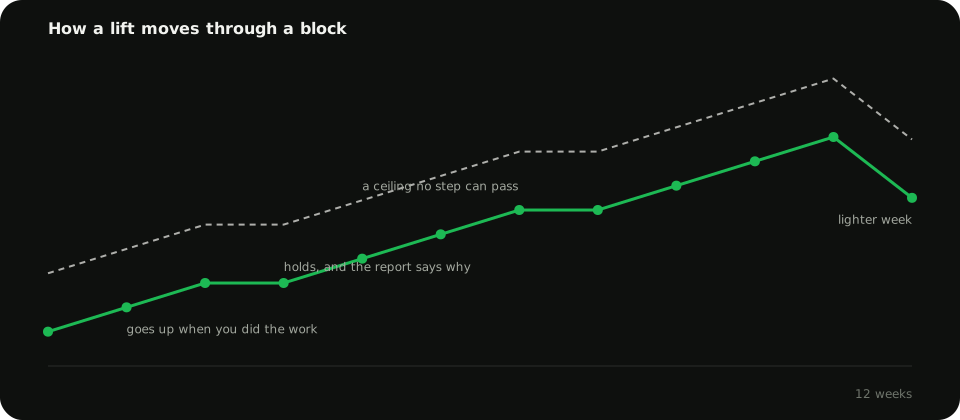
Say your bench press starts a block at 60 kg (132 lb). Week 1 you do the work. Monday the bar is a little heavier, with the line that says so. Week 2 the last set stops short. Monday the weight holds, and the report says why. Week 3 you do the work, and it moves again. Week 4 is a fight on every set. Monday the bar is a little lighter, and the reps come back with it. The final week of the block is the light one.
The figure shows the clean version, where every week earned its step. Real blocks rarely look like that, and most weeks end in a hold with a rep or two more as the work. The holds are what make the plan yours. The next-week load calculator shows what one week of your own numbers does to the next.
What the coach can do to a weight
The coach can suggest a load change for a lift this week, as a card. Accept it and the week changes. Ignore it and the week stays as written. No card can pass the ceiling, and the conversation itself changes nothing. The rest of what the coach can suggest is in how the AI coach works.
What this asks of you
Two things. Log the weight you actually used and the reps you actually got, even when they differ from the plan, because what you log is what next week is built on. And take the lighter week when it comes. A full-load week straight after a holiday is where tendons complain.
Sources
- Ratamess NA et al. (2009). American College of Sports Medicine position stand. Progression models in resistance training for healthy adults. Medicine & Science in Sports & Exercise, 41(3), 687–708. PubMed
- Coleman M et al. (2024). Gaining more from doing less? The effects of a one-week deload period during supervised resistance training on muscular adaptations. PeerJ, 12, e16777. PeerJ