
The short answer
Deload when the signs pile up: top sets slowing or planned reps not arriving two weeks running, sleep and appetite going sideways, small aches that no longer clear between sessions, dread where there used to be appetite. On a program, the deload is already written at the end of each block; take it when it comes.
A deload is lighter and shorter work with the same exercises, on the same days. Take 10 to 20 percent off the bar and halve the sets, keep the movements, keep the schedule, and come back the week after at the loads you were lifting before.
What a deload is
A 2023 Delphi study asked experienced strength and physique coaches, over three rounds, to agree on what a deload is and how it should be used. Their consensus definition: a period of reduced training stress designed to reduce physiological and psychological fatigue, aid recovery, and improve readiness for the training that follows (Bell et al., 2023, Sports Medicine – Open). “Reduced”, not “no”: the coaches kept training through the deload. And the point of the week is the weeks after it.
Six signs you need one
- The bar slows down at the same weight. Your top sets look and feel heavier than they did at that load two weeks ago.
- Planned reps stop arriving. You programmed eight and got six, twice in a row, on more than one lift.
- Aches outlast the rest day. Elbows, knees, lower back, the usual places, still talking on the morning of the next session.
- Sleep and appetite drift. You wake early, or you are not hungry on heavy days, with no other reason.
- You dread sessions you used to want. Dread is a recovery signal, and one of the earlier ones.
- The block is ending. Eight to twelve hard weeks is a lot of accumulated fatigue even when none of the above has shown up yet.
One sign is a bad week. Two or three for two weeks is a deload.
What to cut and what to keep
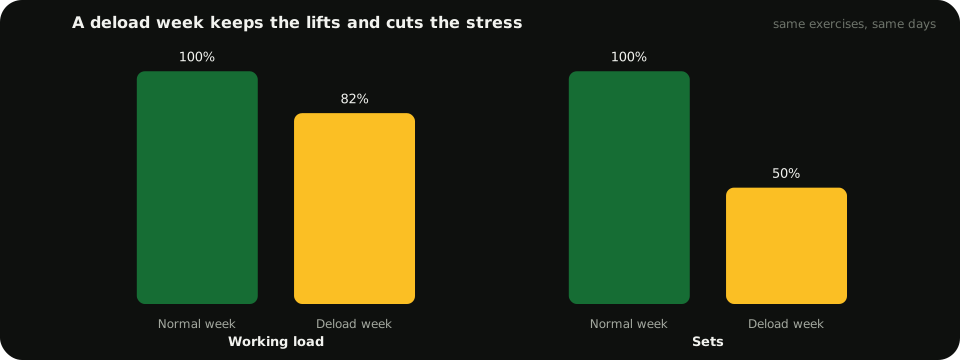
| Normal week | Deload week | |
|---|---|---|
| Exercises | your program | the same |
| Working load | 100% | 10 to 20 percent lower |
| Sets per exercise | your program | about half, rounded down, never below two |
| Reps per set | your program | the same |
| Sessions | your schedule | the same days |
| Effort | hard but clean | smooth, three or more reps in reserve |
Keeping the exercises and the days is what separates a deload from a week off. The pattern gets rehearsed at a load that costs nothing, the habit survives, and the Monday after is just the next week. Round the load to what the rack has: ten to twenty percent off a 60 kg bench is 48 to 54 kg, so take 50 and do not spend the week hunting for the half-kilo plates. The range is the one the coaches in that consensus settled on, less volume and a little less load, and I know of no trial that has run one figure inside it against another.
Asked to pull one lever only, I would cut sets before load. The bar still feels like the bar, and a session that ends twenty minutes early is the part the elbows and the sleep notice.
Why not just take the week off
Because it costs more. A 2024 trial put trained lifters through nine weeks of supervised training; half of them took a complete week off in the middle. At the end, the group that rested lost ground on lower-body strength compared with the group that trained through, while muscle growth, power and endurance were the same (Coleman et al., 2024, PeerJ). A week with no training is a week in which the movement is not practiced and the nervous system is not asked anything, and strength is partly a skill. A light week keeps the practice and sheds the fatigue.
How often
On a structured program the deload belongs at the end of each block, which for most people means every eight to twelve weeks. Shorter cycles suit lifters over 40, people training around physical jobs or poor sleep, and anyone running high volumes. Longer cycles suit beginners, whose loads are not yet heavy enough to accumulate much fatigue; a beginner’s “deload” is usually just the hold that follows a failed session.
Eight to twelve is convention. The 2023 consensus was run because there was little trial evidence on when to deload or how, and that has not changed much since. What follows is practice, and I know of no trial that has tested it against the alternatives.
Outside a program, the rule is the signs above: two weeks of them earns a lighter week. One deload every two or three months is normal. One every three weeks means the weeks between are too hard or the sleep is too short.
After the deload
The week after a deload starts at the loads you were lifting before it. Fatigue is gone, the pattern is fresh, and the old working weights usually move better than they did. The first step up comes the week after that, once a full week at the old loads has earned it. The common mistake is to treat the deload as a springboard and jump straight past the old numbers; the stall that follows is the fatigue you just shed, back a week early.
What BurnX does
In the app, the last week of every block is a lighter week written into the plan: lighter loads and fewer sets on every exercise, the same days, the same movements. The block summary follows, and the next block starts from the loads you finished on. The same idea applies to a break you did not plan: after time away, every lift comes back lighter for a week before the normal steps resume. How BurnX decides next week’s weights has the rest, and the next-week load calculator shows what a lighter week does to any working weight you enter.