
The short answer
For your first few months on a barbell program, add weight almost every session: 2.5 kg (5 lb) on the squat and deadlift, half that or the same on the bench and press, as long as every rep looks like the one before it. Those gains are mostly your nervous system learning the lifts, and they come fast.
After that honeymoon, the realistic weekly step is a percentage, not a plate. Around 2.5% of the bar is the top of what holds for more than a few weeks in a row, and most weeks earn less. From here the question changes from “how much do I add” to “did last week earn a step at all”.
Why beginners can add weight every session
A new lifter gets stronger between sessions because the movement is being learned; very little muscle is built in 48 hours. Coordination, bracing, bar path and confidence under load all improve quickly, and each of them shows up as more weight on the bar. That is why classic beginner programs add weight every workout and why it works for three to seven months before the first real stalls.
The size of the step matters less than its regularity. A 2.5 kg jump is 5% on a 50 kg squat, which is aggressive and still fine for a beginner. By the time the squat is 100 kg the same plate is 2.5%, and the lifter has grown into it.
Why the step becomes a percentage
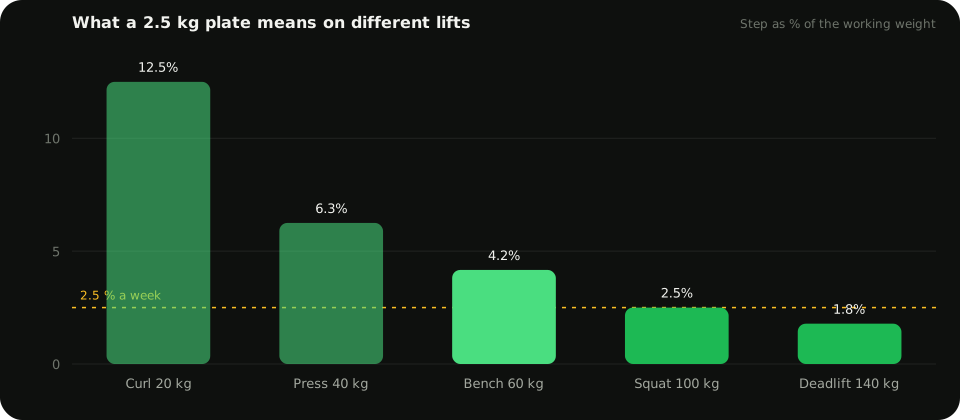
A fixed plate treats every lift the same, and lifts are not the same. The table shows what a 2.5 kg increase means at different working weights.
| Working weight | 2.5 kg step as a percentage | Verdict |
|---|---|---|
| 20 kg (curl, lateral raise) | 12.5% | far too much, most weeks |
| 40 kg (overhead press) | 6.3% | too much for a weekly step |
| 60 kg (bench press) | 4.2% | occasional, not weekly |
| 100 kg (squat) | 2.5% | about right |
| 140 kg (deadlift) | 1.8% | conservative |
Once you are past the beginner phase, a step expressed as a percentage keeps the increase proportionate: 2.5% is 1 kg on a press and 3.5 kg on a deadlift, which is roughly how fast each of them can actually move. A kilo on a press is a 0.5 a side, and most gyms do not stock one, which is why the overhead press is the lift that sends people out to buy their own fractional plates and carry them in the gym bag. The American College of Sports Medicine’s position stand on progression puts the increase at 2 to 10% once you can perform one to two reps beyond the target on two consecutive sessions (Ratamess et al., 2009). The low end of that range is what holds week after week; the high end is a beginner’s first month.
The 2.5% figure itself does not come from a trial. It is where coaching practice has settled for lifters past the beginner phase, and the ACSM range, wide as it is, is the nearest thing to evidence for it.
Reps are progress too
Adding weight is one way to do more. Adding reps at the same weight is another, and for building muscle the evidence puts them side by side. An eight-week randomized trial in trained lifters compared raising the load with raising the reps, and both groups grew the same; strength tilted very slightly toward the load group, by an amount the authors called of questionable practical significance (Plotkin et al., 2022).
The practical form of this is double progression: pick a rep range, say eight to twelve, hold the weight until every set reaches twelve, then add weight and drop back to eight. The weekly step is smaller on paper and far more sustainable, and it has a built-in answer to the week the weight would not move: add a rep. Given the choice I would run every upper-body lift this way from the first stall onward, and keep plate steps for the squat and deadlift, where 2.5 kg is still a small share of the bar.
What should change the step
Whether the reps arrived. The top of the range reached across the sets: the step. Inside the range but short of the top: hold the weight and add reps. Below the range on a day that felt hard: a small step back, which is cheaper than the stall that follows pretending. A lift you did not train earns nothing either way. A missed week is no evidence that the weight was easy, and no evidence that it was hard either.
Time away. After a longer break, the first week back should be lighter. Strength survives a fortnight; what fades faster is the tolerance of tendons and joints and the groove of the movement. Coming back at the old weight is where the “I was fine before the holiday” injuries come from.
The size of the jump. Whatever a rule, a coach or your mood suggests, a single week should never add a leap. Put a ceiling on the step and keep it. Nothing physiological needs a leap, and when one gets proposed it is almost always a logging error or a bad day of judgement.
Where this stops working
Linear and percentage progression both assume recovery keeps up. It stops keeping up at different points for different people: sooner for upper-body lifts, sooner past 40, sooner on five hours of sleep. The signs are the same each time. The top sets slow down, the reps you planned stop arriving, two weeks in a row. A bigger step will not fix that. A hold, a deload, or a change in how the progression is run might, and that is the subject of when to deload.
What this looks like in BurnX
BurnX sets each lift’s weight every week from what you actually lifted: up when you did the work, a hold when you did not, with the reason written next to the number in the Monday report. No step passes the hard ceiling. How BurnX decides next week’s weights has the rest.