
What is progressive overload?
Doing slightly more than last time, on purpose, for months: more weight, more reps, more sets, or more sessions for a muscle. The step that holds week after week is small, about 2.5% of the bar once the first months are over, taken only after a week in which every set reached the top of its rep range.
This is for anyone who has heard the phrase, has lifted for one to three years, and wants to use it on this week’s sessions.
A muscle adapts to the work it is given and then stops, because the work is no longer new. Raising the demand a little at a time keeps the adaptation going. The American College of Sports Medicine’s position stand on progression gives the rule most coaches quote: increase the load by 2 to 10% once you can perform one to two reps over the target on two consecutive sessions (Ratamess et al., 2009, Medicine & Science in Sports & Exercise).
Two words in that sentence do the work. “Once” means the increase is earned by reps already done, not scheduled in advance. “Two” means one good day is not enough. The rest of this page is those two words applied to a real rack.
What are the four ways to overload?
Weight on the bar is one lever. There are three others, and part of training well is knowing which to pull this week.
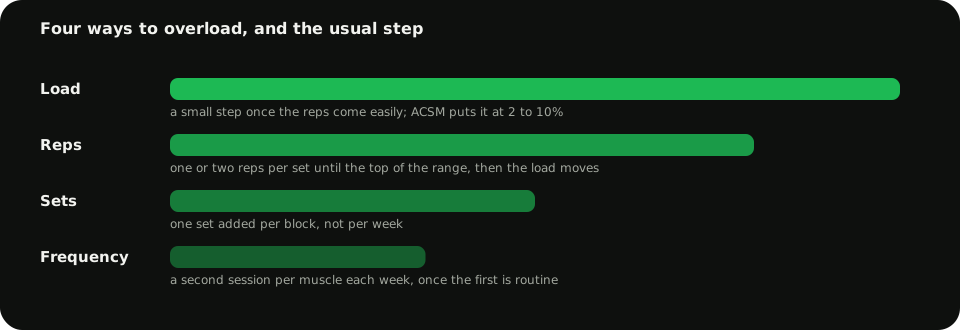
Load. More weight for the same reps. The lever for the big barbell lifts, where a 2.5 kg step is a small share of the load and the plates exist to make it. Pull it when every set of a lift reached the top of its range last week.
Reps. More reps at the same weight, inside a range such as 8 to 10. The lever when the next load step is too large: an overhead press where 2.5 kg is 6% of the bar, or a dumbbell rack that climbs 2 kg at a time, which on a 10 kg lateral raise is a 20 percent jump, and the 12s are gone by six in the evening anyway. Reps also fill the weeks between load steps. When every set reaches the top of the range, the load moves and the reps drop back to the bottom.
Sets. More sets per lift or per muscle. The slowest lever and the most expensive in recovery, so it belongs to blocks rather than weeks. Add a set when load and reps have both stalled for a block and sleep and appetite are holding. Take it away again in the deload.
Frequency, or density. A second weekly session for a muscle that was getting one, or the same work in less time by trimming rest. A 2016 meta-analysis found that training a muscle twice a week built more muscle than once, with volume held roughly equal, and could not settle whether three beats two (Schoenfeld, Ogborn & Krieger, 2016, Sports Medicine). One to two is the frequency step worth taking. Past two the evidence thins. Density is the travel version: when the hotel rack ends at 25 kg, 60 seconds of rest instead of 120 is more work in the same session.
Most weeks you pull one lever on each lift, usually load or reps. Pulling two at once is how a good month becomes a sore one.
How much weight should I add each week?
The literature gives 2 to 10%. Take the bottom of it. Around 2.5% of the bar is the step that keeps holding once the beginner months are over, and most weeks earn less than that. How much weight to add each week works through why the step turns from a plate into a percentage.
A percentage runs into the rack. 2.5% of a 60 kg squat is 1.5 kg, and no bar takes 0.75 kg a side, so under about 100 kg the step you can actually make is a 1.25 a side, 2.5 kg in all. Past 100 kg the plate and the percentage meet, which is also about where a lifter stops being a beginner on that lift.
The step is earned the same way every time, by reps already done: the top of the range reached across the planned sets. A set short, or a rep short on the last set, is a hold, and the missing reps are the coming week’s work. That is the ACSM criterion with the range standing in for “one to two reps over target”.
Can you progress with reps instead of weight?
Yes, and for building muscle the two are hard to tell apart. An eight-week randomized trial in 43 trained lifters ran two groups on the same lower-body program. One added load each week with reps fixed, the other added reps with load fixed. Both grew the same amount of muscle. Strength on a squat test tilted toward the load group by 2 kg, which the authors called of questionable practical significance (Plotkin et al., 2022, PeerJ).
So reps are no consolation prize. For size, a week in which every set went from 8 to 10 at the same weight is a week of progress. For strength, load matters a little more, so once the top of the range arrives, take the step. Reps fill the range, load resets it.
Where does progressive overload go wrong?
Four ways, and between them they account for most stalls.
Unbounded steps. A plan that adds 2.5 kg every session, three sessions a week, adds 7.5 kg a week, and a 60 kg squat is 120 kg by week 9. The plan counts weeks and never reads the log, and by month two it has left the lifter behind. When a training app should lower your weight covers what a counter cannot do.
Chasing load on every lift every session. The curl does not progress like the deadlift. Small lifts and dumbbell lifts spend most weeks on reps because the next plate or dumbbell is a 5 to 10% jump. Expect a load step on every lift every week and a missed step is guaranteed somewhere, and the miss gets read as failure.
Ego sets. The heavier attempt that was not completed, written down as if it were. It poisons the next rule that reads the log, which now adds to a number that was never real. A step you did not earn is a step you give back. Ego lifting covers how to catch it in yourself.
No plan for a missed week. Life removes a week from most 12-week programs. Without a rule the lifter either comes back at the old load and finds it heavy, or jumps to where the plan says they should be. The rule: after one missed week, hold. After a longer break, one slightly lighter week, then normal steps. A 2024 trial found that a full week off in the middle of a nine-week program cost lower-body strength but not muscle size (Coleman et al., 2024, PeerJ). What came back stale is the skill, and skill returns fast, which is why the return is lighter and brief.
Which lever, and when?
Coaches who keep lifters progressing for years pull the four levers in a fixed order, and the order is convention rather than trial evidence. The ACSM range is the nearest thing to proof for the load step. I would sign the table.
| Lever | The usual step | Pull it when | Leave it alone when |
|---|---|---|---|
| Load | a plate on a barbell lift, the next pair on a dumbbell lift | the reps at the top of the range came easily last week | the next step is a 5 to 10% jump; use reps instead |
| Reps | one or two per set, inside the range | the load step is too coarse, or the week did not earn a load step | the top of the range is reached on every set; the load moves now |
| Sets | one per lift, per block | load and reps have both stalled for a block and sleep and appetite are holding | you are already sore for most of the week |
| Frequency | a second session per muscle each week | the first session feels routine | you are at two already; past two the evidence thins |
Two limits sit over all four. A hard miss earns a slightly lighter week rather than another attempt at the same load, and no single week should add a leap, whatever a plan, a coach or a mood suggests. The ceiling rarely binds a lifter who follows the table. It is there for the odd week, the log typo or the plan written by someone optimistic, and in each case the next load is bounded by the last one actually lifted.
A worked example: squat, eight weeks
Three sets of 8 to 10 on the squat, once a week, starting at 60 kg (132 lb).
Week 1, every set at the top: a plate goes on. Week 2, one rep short on the last set: hold, and the missing rep is the week’s work. Week 3, every set at the top: a plate. Week 4, the same. Week 5, no squat session, because a work trip took the week: hold, since there is nothing to step from. Week 6, short of the top on every set, though the session felt normal rather than hard: hold. Week 7, every set at the top: a plate. Week 8, one rep short on the last set: hold going into week 9.
Eight weeks, four steps, three holds and one missed week. The rep lever carried weeks 2, 6 and 8, the load lever carried the rest, and the missed week cost exactly one week. A plan that added a plate every week regardless would be a long way ahead of this lifter by week 9, asking for a load the log has never seen. The next-week load calculator shows what one week of your own numbers does to the next.
What does BurnX do with this?
In BurnX the weight on a lift goes up when you did the work last week, holds when you did not, and comes down after a hard week, after time away and in the last week of a block. Next week starts from what you actually lifted, under a hard ceiling. How BurnX decides next week’s weights says it in full, the 12-week beginner program is a free program built on the same idea, and the rest of the guides are in the hub.
Sources
- Ratamess NA et al. (2009). American College of Sports Medicine position stand. Progression models in resistance training for healthy adults. Medicine & Science in Sports & Exercise, 41(3), 687–708. PubMed
- Plotkin D et al. (2022). Progressive overload without progressing load? The effects of load or repetition progression on muscular adaptations. PeerJ, 10, e14142. PeerJ
- Schoenfeld BJ, Ogborn D, Krieger JW (2016). Effects of resistance training frequency on measures of muscle hypertrophy: a systematic review and meta-analysis. Sports Medicine, 46(11), 1689–1697. PubMed
- Coleman M et al. (2024). Gaining more from doing less? The effects of a one-week deload period during supervised resistance training on muscular adaptations. PeerJ, 12, e16777. PeerJ