
The short answer
Train three days a week, full body, for 12 weeks. Weeks 1–4: learn five lifts at 8–12 reps, starting with the empty bar. Weeks 5–8: add a set and take the main lift of each day to 6–10 reps. Weeks 9–11: the main lift at 5–8. Week 12: lighter loads, fewer sets. Add weight to a lift only after every set reached the top of its range two sessions running.
This is for someone with a gym membership or a pair of adjustable dumbbells, who has started programs before and never reached the end of one.
Why a program that ends
Most beginner programs do not end. They are a session you repeat until you stop, and the stopping is what you remember. This one has a last day. On the first Monday you already know what week 11 looks like and that week 12 is easy, so a missed session has somewhere to go: you repeat the week. It is harder to quit a program for being a week behind when the program has an end.
Twelve weeks is also about as long as one set of rules holds for a new lifter. The first month is learning. The middle month is the fastest progress you will ever make. By week 11 the loads are heavy enough that a light week is owed, and after it the rules change a little, which is what a new block is.
Why three full-body days a week
The ACSM position stand on progression models puts novices at two to three sessions a week, lifting loads they can manage for 8–12 reps (Ratamess et al., 2009, Medicine & Science in Sports & Exercise). Three is the upper end of that, and it is the number that makes full-body sessions work: each pattern gets practiced twice a week with a rest day in between.
The twice matters. A 2016 meta-analysis compared training a muscle once a week with training it twice or more, volume held roughly equal, and found more muscle growth at the higher frequency (Schoenfeld, Ogborn & Krieger, 2016, Sports Medicine). The authors said plainly how little data they had on three times against two. For a beginner, two is the floor worth hitting.
Frequency matters even more in the first weeks because the early gains are mostly skill. A 2017 systematic review of short-term training studies found that the strength added in the first weeks arrives alongside measurable changes in how the nervous system drives the muscle, with less inhibition in the pathway from the brain to the working fibers, before much new muscle has been added (Kidgell et al., 2017, Sports Medicine). The studies in that review are small and the measurements are indirect, so treat the mechanism as the best current account rather than something settled. What is not in doubt is that skill comes from repetitions, and three short sessions give a lift more of them than one long one.
How the 12 weeks are laid out
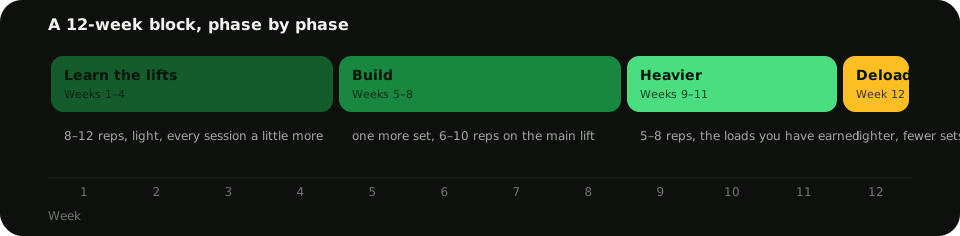
Three blocks of four weeks, with the last week of the third block turned into a deload.
- Weeks 1–4, learn. Every lift at 8–12 reps. Barbell lifts start with the empty bar in week one. The main lift of each day gets three sets, everything else two.
- Weeks 5–8, build. The main lift of each day gets a fourth set and moves to 6–10 reps. Everything else stays at two sets of 8–12.
- Weeks 9–11, heavier. The main lift moves to 5–8 reps, still four sets. Everything else unchanged.
- Week 12, deload. Every lift with 10 to 20 percent off the week-11 load, two sets, same reps, same days.
The only thing that changes between blocks is the main lift’s sets and rep range. The secondary lifts, the carries and the core work run at 8–12 for two sets from the first week to the eleventh, moving up in weight on the same rule as everything else.
The five patterns and their lifts
Every session is built from five movement patterns. Each has a barbell version for a gym and a dumbbell version for a home setup or a crowded rack. Pick one column and stay in it for the block. Switching lifts mid-block resets your numbers.
| Pattern | Barbell version | Dumbbell version |
|---|---|---|
| Squat | Back squat | Goblet squat; dumbbell front squat once the heaviest dumbbell is easy for 12 |
| Hinge | Romanian deadlift (weeks 1–4), then deadlift from the floor | Dumbbell Romanian deadlift |
| Push | Bench press; overhead press on day 2 | Dumbbell bench press or floor press; dumbbell shoulder press on day 2 |
| Pull | Barbell row; lat pulldown or chin-up on day 2 | One-arm dumbbell row; chin-up on day 2 if you have a bar, otherwise the row again with a two-second pause at the top |
| Carry or core | Farmer’s carry with two dumbbells; dead bug on day 2 | Farmer’s or suitcase carry; dead bug on day 2 |
The barbell hinge starts as a Romanian deadlift because an empty bar cannot be pulled from the floor: without full-size plates it sits at mid-shin. From week 5, when you have at least 20 kg of plates a side or can set the bar on blocks at the right height, the day-2 hinge becomes the deadlift from the floor. The Romanian deadlift stays on day 3 as the second hinge.
The three days
Each day has one main lift, two or three secondary lifts and a carry or core finisher. Rest two to three minutes between sets of the main lift and 60 to 90 seconds on everything else. A session takes 45 to 60 minutes once you know the lifts.
- Day 1: back squat (main), bench press, barbell row, farmer’s carry.
- Day 2: hinge (main), overhead press, lat pulldown or chin-up, dead bug.
- Day 3: bench press (main), back squat, Romanian deadlift, barbell row, farmer’s carry.
The squat, the bench and the row each appear twice a week: once as a main lift or at full weight, once as a secondary lift. That is what makes the progression rule below work on a weekly clock. The hinge from the floor and the overhead press appear once a week, and their steps come half as often.
Warm up each main lift with two or three lighter sets before the first working set: the empty bar for a few reps, then about half and about 80% of the working weight, three reps each. The warm-up sets calculator writes those sets for any working weight.
Weeks 1–4: learn the lifts
| Day | Lift | Sets × reps | Load |
|---|---|---|---|
| 1 | Back squat (main) | 3 × 8–12 | Empty bar in week 1, then found in week 2 |
| 1 | Bench press | 2 × 8–12 | Same |
| 1 | Barbell row | 2 × 8–12 | Same |
| 1 | Farmer’s carry | 3 × 30 m | Heaviest pair you can carry without leaning |
| 2 | Romanian deadlift (main) | 3 × 8–12 | Empty bar in week 1, then found in week 2 |
| 2 | Overhead press | 2 × 8–12 | Same |
| 2 | Lat pulldown or chin-up | 2 × 8–12 | A weight that leaves three reps at 12 |
| 2 | Dead bug | 3 × 8 per side | Body weight |
| 3 | Bench press (main) | 3 × 8–12 | The day-1 bench weight |
| 3 | Back squat | 2 × 8–12 | The day-1 squat weight |
| 3 | Romanian deadlift | 2 × 8–12 | The day-2 weight |
| 3 | Barbell row | 2 × 8–12 | The day-1 row weight |
| 3 | Farmer’s carry | 3 × 30 m | As day 1 |
Week 1 is the empty bar. Every barbell lift, every set, 20 kg (45 lb), however light it feels. Check the end cap before you trust that number: a 15 kg bar and a 20 kg bar look the same from across the room, and some gyms keep a lighter technique bar in the same rack. You are learning where your feet go, how the bar sits, how to breathe under it. Nothing you lift in week one will matter in week ten. The pattern will. With dumbbells, use the lightest pair you can do 12 clean reps with.
Week 2 is for finding the weight. On each lift, start again at the bar and add 2.5 kg a set until a set of 12 feels like you have about three reps left. That is your working weight. Write it down. It is the number every later week is built on. Most people land somewhere between 30 and 50 kg on the squat, less on the presses, and that is fine. How to pick a starting weight walks through this in more detail.
Weeks 3 and 4 run the rule. Every set at the working weight for 8–12 reps. When every set of a lift reaches 12 in both of its sessions that week, add 2.5 kg next week. When it does not, hold the weight and let the reps climb.
Weeks 5–8: add a set, go to 6–10
| Day | Lift | Sets × reps | Load |
|---|---|---|---|
| 1 | Back squat (main) | 4 × 6–10 | Week-4 load plus one step |
| 1 | Bench press | 2 × 8–12 | Day-3 bench load minus 10% |
| 1 | Barbell row | 2 × 8–12 | By the rule |
| 1 | Farmer’s carry | 3 × 30 m | Heavier pair when 30 m is easy |
| 2 | Deadlift (main) | 4 × 6–10 | Found in week 5 from the bar with plates |
| 2 | Overhead press | 2 × 8–12 | By the rule |
| 2 | Lat pulldown or chin-up | 2 × 8–12 | By the rule |
| 2 | Dead bug | 3 × 10 per side | Body weight |
| 3 | Bench press (main) | 4 × 6–10 | Week-4 load plus one step |
| 3 | Back squat | 2 × 8–12 | Day-1 squat load minus 10% |
| 3 | Romanian deadlift | 2 × 8–12 | By the rule |
| 3 | Barbell row | 2 × 8–12 | By the rule |
| 3 | Farmer’s carry | 3 × 30 m | As day 1 |
The main lift of each day changes in two ways. It gets a fourth set, and the target drops to 6–10 reps. A weight you did for 12 in week 4 you can do for 10 at the start of week 5, so the main lift takes one step up at the block change: 2.5 kg on the squat and deadlift, 1.25 to 2.5 kg on the bench.
The second appearance of the squat and the bench becomes a lighter day: the main-day load minus 10%, rounded down to the nearest 2.5 kg, for two sets of 8–12. Those sets are practice at a load that costs little. If the main day is 50 kg, the light day is 45 kg.
Week 5 is where the deadlift from the floor replaces the Romanian deadlift on day 2. Find its weight the way you found the others: from the bar with the lightest full-size plates, 2.5 kg a set until 10 reps feels like three left. If your gym has no full-size plates lighter than 20 kg and 60 kg is too much for 10, pull from blocks or the rack’s safety pins set at mid-shin until it is not.
Weeks 9–11: heavier on the main lift
| Day | Lift | Sets × reps | Load |
|---|---|---|---|
| 1 | Back squat (main) | 4 × 5–8 | Week-8 load plus one step |
| 1 | Bench press | 2 × 8–12 | Day-3 bench load minus 10% |
| 1 | Barbell row | 2 × 8–12 | By the rule |
| 1 | Farmer’s carry | 3 × 30 m | By the rule |
| 2 | Deadlift (main) | 4 × 5–8 | Week-8 load plus one step |
| 2 | Overhead press | 2 × 8–12 | By the rule |
| 2 | Lat pulldown or chin-up | 2 × 8–12 | By the rule |
| 2 | Dead bug | 3 × 12 per side | Body weight |
| 3 | Bench press (main) | 4 × 5–8 | Week-8 load plus one step |
| 3 | Back squat | 2 × 8–12 | Day-1 squat load minus 10% |
| 3 | Romanian deadlift | 2 × 8–12 | By the rule |
| 3 | Barbell row | 2 × 8–12 | By the rule |
| 3 | Farmer’s carry | 3 × 30 m | By the rule |
Three weeks, and the fourth is the deload. The main lift drops to 5–8 reps and takes one more step at the block change. Four sets of five to eight at a weight you can only just manage for eight is the first time in the program the bar feels heavy, and the first time rest between sets matters. Take the full three minutes.
Nothing else changes. The secondary lifts keep their two sets of 8–12 and keep stepping on the rule. By now the empty-bar weeks will feel a long way back, and the squat on day 3 at 10% under the main day will feel like a warm-up. That is correct. Leave it.
Week 12: the deload
| Day | Lift | Sets × reps | Load |
|---|---|---|---|
| 1 | Back squat | 2 × 5–8 | 10 to 20 percent off the week-11 main-day load |
| 1 | Bench press | 2 × 8–12 | 10 to 20 percent off the week-11 load |
| 1 | Barbell row | 2 × 8–12 | 10 to 20 percent off |
| 1 | Farmer’s carry | 2 × 30 m | A lighter pair |
| 2 | Deadlift | 2 × 5–8 | 10 to 20 percent off the week-11 load |
| 2 | Overhead press | 2 × 8–12 | 10 to 20 percent off |
| 2 | Lat pulldown or chin-up | 2 × 8–12 | 10 to 20 percent off |
| 2 | Dead bug | 2 × 12 per side | Body weight |
| 3 | Bench press | 2 × 5–8 | 10 to 20 percent off the week-11 main-day load |
| 3 | Back squat | 2 × 8–12 | 10 to 20 percent off the week-11 light-day load |
| 3 | Romanian deadlift | 2 × 8–12 | 10 to 20 percent off |
| 3 | Barbell row | 2 × 8–12 | 10 to 20 percent off |
| 3 | Farmer’s carry | 2 × 30 m | A lighter pair |
Same lifts, same days, same reps. Take 10 to 20 percent off every load and cut the sets to two. Every set should move smoothly with three or more reps in reserve, and you should leave the gym feeling you could have done more. Round to the plates you have.
A deload is not a week off, and the distinction has been tested. A 2024 trial took trained lifters through nine weeks of training, and half of them took a complete week off in the middle. The group that rested lost ground on lower-body strength compared with the group that kept training, while muscle growth was the same (Coleman et al., 2024, PeerJ). A light week keeps the movement practiced and the habit intact while the fatigue of eleven weeks drains out.
The range comes from a 2023 consensus of experienced strength and physique coaches, who agreed that a deload means less volume and a little less load on the same lifts (Bell et al., 2023, Sports Medicine – Open). The trial above compared a week off with training as normal, and I do not know of one that has run beginners at one figure inside the range against another. Take it as what works in practice, and round it to the plates you have. When to deload covers what a deload is for and what to cut.
How to add weight each week
The position stand’s rule for novices is to increase the load by 2–10% once you can do one or two reps over the target on two consecutive sessions (Ratamess et al., 2009). This program uses the same trigger with a fixed target, and takes the low end of the range.
The rule: when every set of a lift reaches the top of its rep range in two sessions running, add one step the next time you do that lift. Otherwise hold the weight and let the reps come up.
One step is 2.5 kg (5 lb) on the squat, deadlift and row, and 1.25 to 2.5 kg on the bench and overhead press, depending on what plates your gym has. Most gyms own a pair of 1.25 kg plates. They are rarely on the tree. Look under a bench or on the floor by the dumbbell rack. They are worth the walk, because 2.5 kg on a 30 kg press is a step of more than 8%. With dumbbells, one step is the next pair up. When the next pair is a jump of more than 10%, which is common above 20 kg, stay on the current pair and run the reps to the top of the range for another week before moving.
In practice:
- Lifts you do twice a week step weekly. The squat, the bench and the row appear in two sessions, so “two sessions running” is one week. The deadlift from the floor and the overhead press appear once, so their steps come every two weeks at most. That is slower, and it is also about right for the two lifts where form breaks first under a step that came too soon.
- The light day counts. In blocks 2 and 3 the squat and bench have a lighter second session at 8–12. Both sessions must hit the top of their range for the step. The light day almost always will. The main day is the real test.
The percentage is large at the start and small later. A 2.5 kg plate is 12.5% of an empty bar and 5% of a 50 kg squat, and by 100 kg it is 2.5%. The plate does not change, so the early weeks move fast and the later ones slow down, which is the shape of a beginner’s progress anyway. How much weight to add each week covers what happens to the step once the first months are over.
What does not count as earning a step: one good set, a set with a spotter’s hands on the bar, or reps that were shorter than the ones in week one. If the range or the control shrank to get the number, the number was not reached. If I were not sure whether the last rep was as deep as the first, I would count the set as 11 and hold. The hold costs a week. A step taken on a short rep usually gets taken back a few weeks later, with a stall in between.
One lift across 12 weeks: the squat from the empty bar
Here is the back squat for a lifter who starts at the bar, finds 30 kg in week 2, and follows the rule without exception. The reps are the main day’s sets. It is one plausible run. Your numbers will differ.
Week 1 is the empty bar, twelve reps on every set, and the job is the pattern. Week 2 finds the weight: 30 kg feels like three reps left at twelve, and that number goes in the book. Weeks 3 and 4 both reach twelve on every set, so each earns a plate, except that week 4 misses the last set by a rep. The block change steps anyway, because the target drops from twelve to ten and the weight will sit inside the new range. Week 5, the first at four sets of 6–10, ends 10, 10, 10, 8: a hold. Week 6 gets ten across and earns a plate. Week 7 ends 10, 10, 9, 8, a lifter one week away from ten across, and holds. Week 8 proves it with ten across, and the block change steps again as the range drops to 5–8. Week 9 ends 8, 8, 7, 6 and holds. Week 10 gets eight across and earns a plate. Week 11 ends 8, 7, 7, 6, the heaviest week of the program, and the next week is the light one.
Count the steps. Of eleven working weeks, four end in a step on the rule, two in a step at a block change, and four in a hold. Someone who added weight on every good day would have been a plate or two ahead by week 7 and grinding sets of six for a month. A lifter like this one finishes the program a long way past the empty bar, for four sets of eight, with a week-12 load that leaves you fresh for whatever comes next.
Week 12 takes 10 to 20 percent off the week-11 load and rounds it to the plates. Two sets of six at that weight should feel like nothing, and that is the point.
What to do if you miss a week
Repeat it. If you missed week 6, next week is week 6 again at the same loads, and everything after it moves back by one. The calendar does not get a vote. The temptation after a missed week is to skip to the week you “should” be on, or to add the step you would have earned if you had trained; both put a load on the bar that nothing has been done to earn, and the stall that follows gets blamed on the program. Between the two mistakes, I would rather repeat a week I did not need to than take a step nothing earned.
The reason is the same one that makes the deload a light week and not a rest week. A week of nothing is a week in which the lift was not practiced, and in the trial above a week off cost measurable strength. A missed week is already a week off. Do not make it two by coming back to loads that fail.
If you missed one week, repeat it at the same loads. If you missed two or more, run one week at about 10% under your last loads, two sets instead of three or four, then resume the plan at the week you left. The first session back will tell you quickly whether 10% was enough.
A single missed session inside a week is different. Do the session on the next free day if the week has room; if it does not, let it go and treat the week as trained for the lifts you did. One missing session is not a reason to hold the step on the lifts whose two sessions both happened.
What happens after week 12
Week 12 was the light week, so there is nothing to recover from. The following Monday, start the next block from the loads you finished week 11 on, not from the deload loads and not from a one-rep-max test. In the squat run above, that is the week-11 load for four sets, with the first step due the week the rule says.
For most people the right next block is this same program again from the new numbers, with week 1 skipped and week 2 replaced by the loads you already know. Some will want to change one thing: a fourth day, a different squat or press variation, a different goal for the block. What to do after a 12-week program sets out the three options and who each suits.
What BurnX does
The app writes this kind of block for your goal, your days and your equipment, and moves the weights for you from what you logged. A lift’s weight goes up when you did the work last week, holds when you did not, and the last week of the block is the lighter one. Nothing passes the hard ceiling. How BurnX decides next week’s weights has the rest, and the program on this page runs without it.