
Your first day at the gym is 40 minutes and three lifts: 5 minutes walking and arm circles, 10 minutes learning the squat with a light dumbbell, 10 minutes of a push, 10 of a pull, 5 to walk out. Two or three sets of about ten reps, with three left in you. Leave with three numbers written down.
This is for the person who has a membership and no plan.
What should I do on my first day at the gym?
Three movements in a fixed order, then home. Day one has one job: learn the three well enough to repeat them on day three, find a light weight for each, and get out without once standing in the middle of the floor wondering what comes next.
The three are a squat, a push and a pull, which between them cover legs, chest and shoulders, back and arms. Everything else can wait for week two. The sets are short and the weights light on purpose. The American College of Sports Medicine’s position stand on progression recommends that novices train two to three days a week with loads that allow eight to twelve reps per set (Ratamess et al., 2009, Medicine & Science in Sports & Exercise); ten reps with three left in you sits in the middle of that range. Nothing in the research says 40 minutes. The position stand gives the reps and the days; the clock is a coach’s number, picked so the session ends before you have to make a single decision on the floor.
The 40-minute timeline
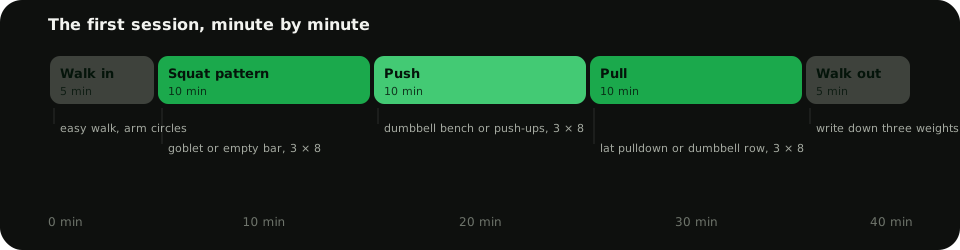
Read it once at home and keep it on your phone. The last column says what “done” looks like for each block, so you know when to move on.
| Minutes | What | Sets and reps | Done looks like |
|---|---|---|---|
| 0–5 | Walk on a treadmill, then arm circles | 5 min brisk walk; 10 circles each way | Warm, slightly out of breath, shoulders loose |
| 5–15 | Goblet squat (or empty-bar squat) | 1 practice set of 10, then 2 × 10 | Thighs near parallel, heels down, last rep slower but clean |
| 15–25 | Dumbbell bench press (or push-ups) | 1 practice set, then 2 × 8–12 | Dumbbells touch at the top each rep, no bounce off the chest |
| 25–35 | Lat pulldown (or one-arm dumbbell row) | 1 practice set, then 2 × 10 | Bar to the collarbone, elbows down, no lean-back heave |
| 35–40 | Walk out | 3 min easy walk; write down three weights | Three numbers in your phone |
Rest 60 to 90 seconds between sets and count it on the phone’s clock. The rest is part of the plan.
Minutes 0–5: walk in and warm up
Go straight to a treadmill. Five minutes at a pace where you could talk but would rather not. Step off, find a few feet of floor near the dumbbells, and do ten slow arm circles forward and ten back. The five minutes on the treadmill also show you where the dumbbells, the benches and the pulldown machine are, so you are not searching for them later with a weight in your hand.
Minutes 5–15: learn the squat
Pick a dumbbell you could carry across the room without thinking about it, usually 6 to 10 kg. Hold it against your chest with both hands cupped under the top end. Feet a little wider than your hips, toes turned slightly out. Sit down between your knees, as if onto a low box, until your thighs are near parallel to the floor. Stand up. Goblet squat.
One set of ten to learn it. If it felt like nothing, take the next dumbbell up. Then two sets of ten, 90 seconds apart. You are looking for heels down, knees following the toes instead of caving in, and a last rep that is slower than the first without being a fight. If it turns into a fight, take the lighter dumbbell for the second set.
The empty barbell works by the same rule, and I would still start everyone on the dumbbell. A standard bar is 20 kg (44 lb), heavier than most first-day goblet squats, and it asks you to learn the rack, the step back and the squat in the same ten minutes.
Minutes 15–25: push
Dumbbell bench press. Take a pair of 6 to 10 kg, sit on the end of a flat bench with the dumbbells standing on your knees, and lie back, bringing them with you. Press them up until they touch above your chest, lower under control until your upper arms are about level with your torso, press again.
One practice set of eight, then two sets of eight to twelve. The dumbbells should meet at the top every rep and come down slowly, and you should stop with three reps still in you. After six in the evening the flat benches are the first thing in the room to go. If they are all taken, do push-ups with your hands on a bench or a box, two sets of as many clean reps as you can, and count that as the push.
Minutes 25–35: pull
Lat pulldown. Set the thigh pad so your knees are held down, take the bar a little wider than your shoulders, and sit. Pull the bar to the top of your chest, elbows driving down and slightly back, then let it rise until your arms are straight. Keep the torso near upright; the temptation is to lean back and heave.
The pin will be wherever the last person left it, usually far heavier than you want. Move it to a light setting before you sit, or the first pull goes nowhere and you will assume the problem is you. One practice set of ten, then two sets of ten. The bar should reach your collarbone every rep, you should feel it between your shoulder blades more than in your biceps, and the stack should not crash. If the pulldown is busy, put one hand and one knee on a bench and row a dumbbell to your hip, two sets of ten each side.
Minutes 35–40: walk out
Three minutes of easy walking, then write three things in your phone: the goblet squat weight, the dumbbell bench weight per hand, and the pulldown setting. Then leave, even though it was not that bad and there is a pull to do one more thing. Day two is in 48 hours.
What gym etiquette actually matters?
Three rules are worth knowing in advance. The rest you will pick up by watching.
Re-rack what you used. Dumbbells go back to the slot with the matching number, plates back on the pegs. Nobody minds a beginner; everyone minds a pair of dumbbells left on the floor.
Wipe the bench and the seat. Most gyms keep spray bottles and paper towels around the room. Use them after anything you sat or lay on.
Do not hover. If the bench or machine you want is taken, take the alternative in the table and come back. Standing two meters behind someone, waiting, makes both of you uncomfortable. If you need to know how many sets they have left, ask, then go and do something else.
You will feel watched. Mostly you are not; people in a gym are looking at the mirror or at their phone. What does draw eyes is someone standing still in the middle of the floor, and the timeline leaves no minute for that.
What should I write down before I leave?
The three weights. As a worked example, a reader of about 70 kg (154 lb) on a first day:
- Goblet squat: the 8 kg practice set felt like nothing, the 12 kg sets felt like work with three reps left. Write down 12 kg.
- Dumbbell bench press: 8 kg per hand for the practice set, 10 kg per hand for the two working sets, last rep slow but clean. Write down 10 kg.
- Lat pulldown: 20 kg on the stack was easy, 25 kg was right. Write down 25 kg.
Those numbers describe one afternoon and nothing else; by week four they will look small. The guide on how to choose a starting weight covers the same method for any exercise you add later. The warm-up sets calculator will matter once your working weights need a ramp, which on day one they do not.
What does day two look like?
Two days later, the same three lifts at the same three weights, with one more working set on each if day one left you fine rather than wrecked. No new weight and no new exercises yet. Repeating three movements while they are fresh teaches them faster than anything you could add, and two to three days a week is the frequency the position stand recommends for a novice.
By the end of week one you will have done each lift twice and you will know your three weights, which is all a proper program needs from you. The 12-week strength program for beginners starts from exactly this place: three days a week, full body, with a rule for when to add weight. The other guides cover what comes after.
What this looks like in BurnX
The session screen in BurnX is this list with the weight already filled in: each exercise with its clip, the weight and reps for the set, a rest ring that counts the 90 seconds, and a tap to log the set. The one decision this article could not make for you, which dumbbell to pick up, comes from what you logged last time, so you know the number before you walk in.